

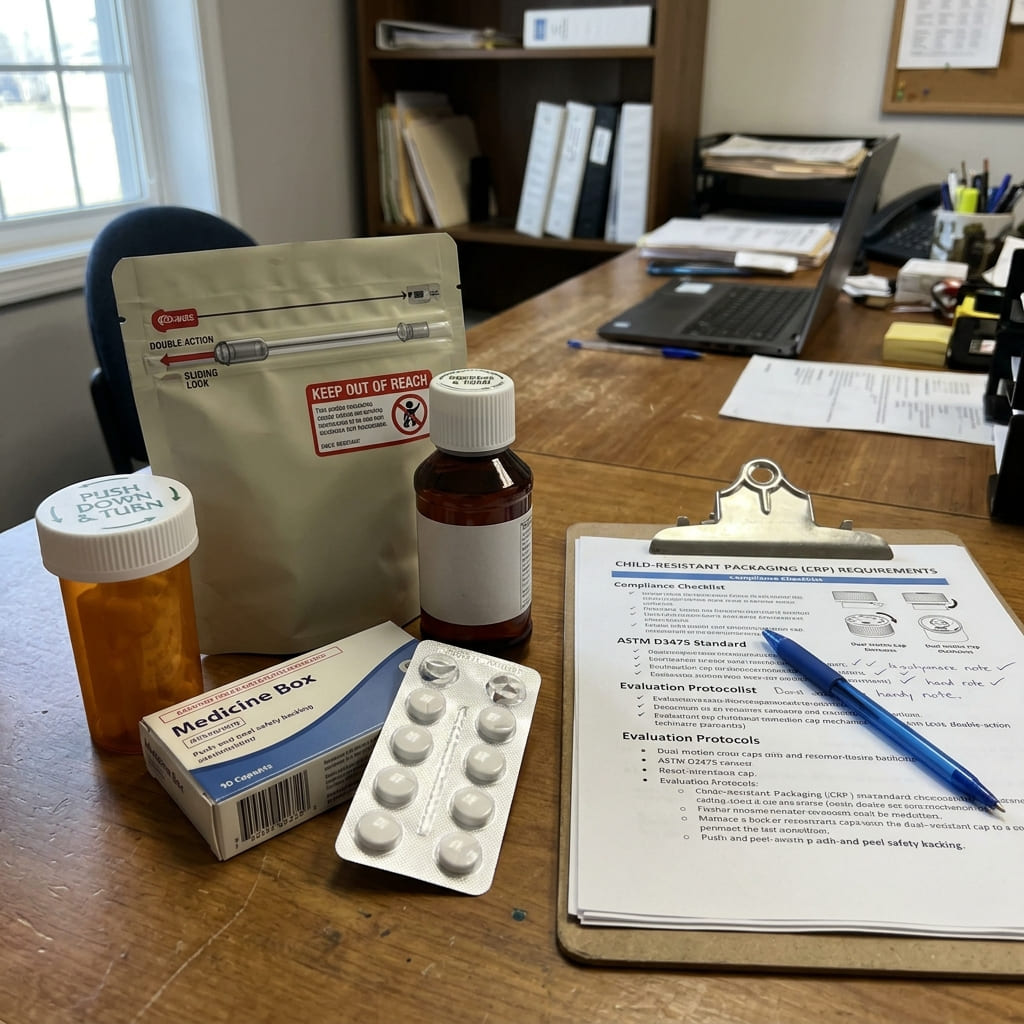
If you search for child resistant packaging requirements from the FDA, you may be surprised by the answer: in the United States, the main federal child-resistant packaging law is not run by the FDA at all. It is the Poison Prevention Packaging Act of 1970, and the Consumer Product Safety Commission (CPSC) enforces it. For CBD brands, the rules that matter most usually come from your state.
That gap causes real confusion. Plenty of CBD brand owners assume there is one federal checklist to follow, then discover that the requirements for a tincture in one state look nothing like the requirements next door.
This guide explains who sets which rules, how a package earns the “child-resistant” label, and what you should confirm before you sign off on a new box. It is general information, not legal advice, so always check the current rules for every state you sell in.
Who Sets Child Resistant Packaging Requirements: FDA or CPSC?
The CPSC sets the federal child-resistant packaging standards, not the FDA. The Poison Prevention Packaging Act, usually shortened to PPPA, gives the CPSC power to require special packaging for household substances that could seriously harm a child.
The FDA’s role is different. It regulates drugs, foods and dietary supplements, including what can be sold and how it is labeled. Even for prescription medicines, the child-resistant packaging requirement itself comes from the PPPA, which is why pharmacy vials follow CPSC testing rules.
This is not a technicality. It changes where you look for answers. If you only read FDA guidance, you will miss the testing standard that defines what “child-resistant” actually means.
Where Does CBD Fit In?
CBD sits in an unusual spot. The FDA has said that the existing frameworks for foods and dietary supplements are not a good fit for CBD, and in early 2023 it asked Congress for a new regulatory pathway. You can follow the agency’s current position on its CBD regulation page.
In practice, that leaves no single federal child-resistant rule written specifically for CBD products. States have filled the space. Some require child-resistant packaging for hemp and CBD products meant to be eaten or swallowed, while others focus on labeling or on cannabis products only.
Florida is a useful example. Its agriculture department publishes hemp extract guidance that points brands to child-resistant standards. California’s cannabis regulator has its own detailed packaging rules for licensed cannabis products, which differ again.
Which Products Already Require Child Resistant Packaging?
The PPPA covers a long list of household substances. Under the CPSC’s rules, this typically includes oral prescription drugs, several common over-the-counter medicines such as aspirin and acetaminophen, iron-containing supplements and a range of household chemicals.
Congress has also added categories over time. The Child Nicotine Poisoning Prevention Act of 2015, for example, brought liquid nicotine containers under child-resistant packaging rules. That history matters for CBD brands because it shows how quickly a product category can move from “no rule” to “required.”
There’s a catch for prescription medicines: patients can ask a pharmacist for a non-child-resistant container, typically for reasons like arthritis. Your CBD customers have no such federal option, so the safest approach is to assume your state may require it.
What Is Considered Child Resistant Packaging?
A package is considered child-resistant when it passes a standardized test, not because of how it looks. A push-and-turn cap or a zipper pouch is only a design. The label “child-resistant” depends on proven test results.
Child-resistant does not mean childproof. No package can stop every child forever. The standard asks whether most young children fail to open it within a set time, while most adults can still open and close it properly.
That second half is easy to forget. A package that children cannot open but older adults also struggle with fails the standard. Good child-resistant packaging is a balance between both groups.
Child Resistant Packaging Testing Requirements
The CPSC testing protocol, set out in 16 CFR 1700.20, uses panels of children aged 42 through 51 months. Children are tested in groups of 50, with up to 200 children in total, and are given a set time to try opening the package, first without help and then after an adult shows them how.
The performance levels come from a separate section, 16 CFR 1700.15. In the edition published there, a package must resist at least 85 percent of children without a demonstration and at least 80 percent after a demonstration. A senior adult panel must also show an effectiveness of at least 90 percent, which means most older adults can open and properly close it.
The table below summarizes how the pieces fit together.
| Requirement | Who sets it | What it means for your CBD packaging |
| Poison Prevention Packaging Act | Congress, enforced by the CPSC | The federal basis for child-resistant packaging in the U.S. |
| Child testing protocol (16 CFR 1700.20) | CPSC | Defines how a package is tested with young children |
| Effectiveness levels (16 CFR 1700.15) | CPSC | Sets the pass levels for children and senior adults |
| CBD product rules | FDA, with a new pathway still pending | Covers what can be sold and claimed, not a CBD-specific child-resistant rule |
| Hemp and CBD packaging rules | Each state | Often the rules that decide whether your box must be child-resistant |
| Packaging certificate | Your packaging supplier or test lab | Proof that a specific design passed testing |
These rules are updated from time to time, so check the current eCFR text before you rely on any specific number.
How to Keep a Premium Look With Child Resistant Packaging
Many brand owners worry that child-resistant packaging means an ugly, clinical pack. That is rarely true now. The child-resistant part is usually a mechanism, and the brand experience comes from everything around it.
Common approaches include:
- A child-resistant inner container, such as a bottle with a push-and-turn cap, inside a printed outer box.
- A child-resistant sliding tray inside a rigid or paperboard sleeve.
- A child-resistant pouch with a printed exterior for gummies and edibles.
The outer box carries your branding, product details and state-required label information, while the inner container handles safety. For a tincture, that might be a child-resistant dropper bottle inside a matte box with foil details. You keep the shelf presence without changing how the safety part works.
There is one important limit: putting a child-resistant bottle inside a nice box only counts if the bottle itself is certified. Ask your bottle or closure supplier for the test documentation, and keep it on file.
What to Confirm Before You Finalize Your Packaging
Before you approve a new design, confirm these five points for each state you sell in:
- Whether the state requires child-resistant packaging for your product type: tinctures, gummies, topicals or pre-rolls.
- Whether the requirement applies to the inner container, the outer package or both.
- Whether the state expects opaque packaging or specific label wording.
- That your supplier can provide test documentation for the child-resistant component.
- Any pending rule changes you should plan for now.
Your packaging supplier can help you choose structures and finishes, but meeting the rules stays your responsibility as the brand owner. When in doubt, ask your state’s agriculture or cannabis regulator directly.
FAQs
Which law requires child resistant packaging?
In the United States, the Poison Prevention Packaging Act of 1970 is the main federal law, and the CPSC enforces it. State laws can add their own child-resistant requirements, which is where most CBD and hemp rules come from.
Does the FDA require child resistant packaging for CBD?
There is no FDA rule written specifically to require child-resistant packaging for CBD products. Child-resistant standards come from the CPSC, while CBD packaging requirements are mostly set by individual states. Check the current rules for every state you sell in.
Which medications require child resistant packaging?
Under CPSC rules, this typically includes oral prescription drugs and several over-the-counter products such as aspirin, acetaminophen and iron-containing supplements. The full list sits in the CPSC’s special packaging regulations and changes from time to time.
What is considered child resistant packaging?
Packaging is considered child-resistant when it passes the CPSC test protocol: most young children cannot open it within the test time, while most senior adults can open and close it properly. The design alone does not qualify it; the test results do.
What is a child resistant container?
A child-resistant container is a bottle, jar, tube, pouch or box with a mechanism that most young children cannot open, such as a push-and-turn cap, a squeeze-and-pull lid or a locking zipper. It should come with test documentation from the supplier.
Safety and Style Are Not Competing Goals
The CBD brands that handle child-resistant rules well treat safety as a structural decision and branding as a surface decision, so neither one has to give way to the other. Once you separate the two, a certified inner container and a well-designed outer box can work together on the same shelf.
If you are planning new packaging, CBD Boxes can help with custom CBD boxes, tincture boxes and gummy packaging designed around child-resistant inner containers. Check your material options with the team before you finalize the design.