

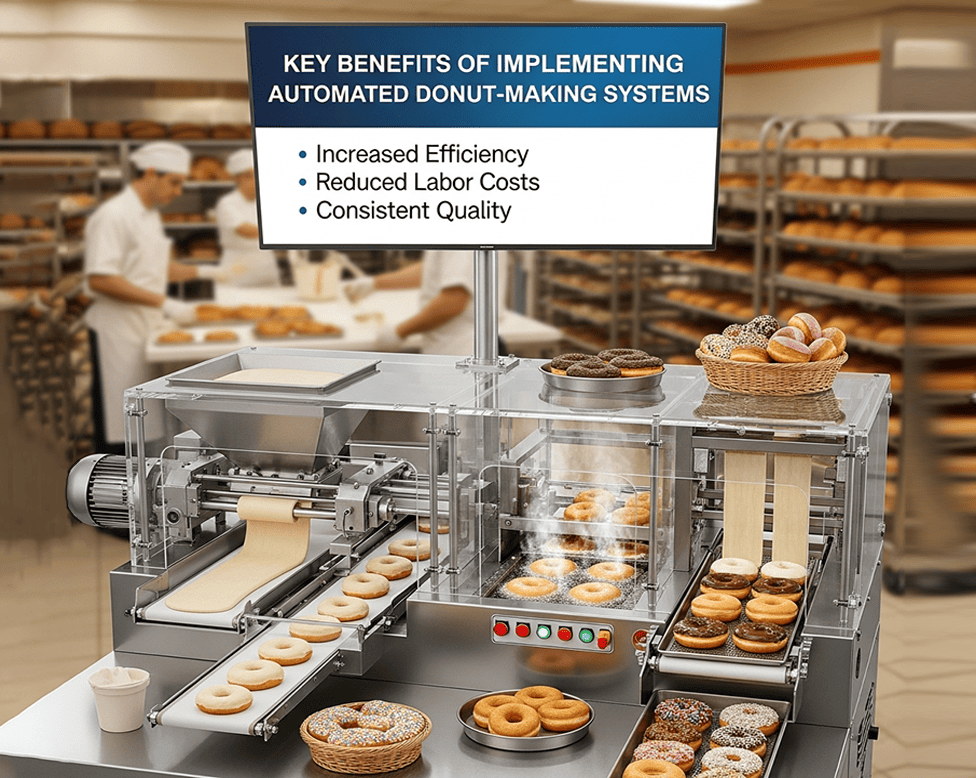
Looking For a Way to up Your Donut Game Without Wearing Your Staff Down?
Every bakery owner wants their operation to be more consistent, productive, and cost-effective. But as they know all too well, these goals are tough to hit with manual production methods. The solution to this problem is an automated donut maker.
The right technology and know-how can change the game for your bakery. Luckily, the right automated donut production systems are more accessible than ever.
What We'll Cover
- Why Automated Donut Production Makes Sense
- The 3 Key Benefits
- Solving the Labor Crisis with Automation
- 4 Steps to Making the Transition
Why Automated Donut Production Makes Sense
The bakery market is big. And it's only getting bigger. In fact, global demand is expected to hit $494.70 billion in 2025 before jumping to $685.82 billion in 2032.
That's a huge opportunity for donut brands that can deliver.
But with opportunity comes competition. Your bakery needs to be ready to churn out product to keep up.
Traditional production methods are built around lots of repetitive, skilled manual work. Staff mix, portion, shape, fry, glaze and box the finished product. But even the best employees get tired and inconsistent. Shifts can become unpredictable. Quality control becomes much harder. A single mistake or misstep can ruin an entire batch.
An automated donut maker is the key to solving these production problems. Automated donut maker manufacturers like Sorting Robotics can provide solutions for your automated donut maker needs from the ground up including hash hole roller equipment to solve some of the most labor-intensive processes during your production line. Automating these stages removes so much of the variability that you can guarantee a consistent product – every time.
Impressed yet?
The 3 Key Benefits
Automation is more than just an interesting technology. Making the switch to automated donut making equipment makes an immediate difference to your business performance.
Here are the top 3 reasons to upgrade your equipment:
Better Production Consistency
The reality of manual donut production is that not every batch comes out the same. Ingredients can be measured slightly differently. Manual frying can lead to some donuts being overcooked and others undercooked. Some days employees are on point. Other times, shifts are plagued with simple but costly mistakes.
Automated systems have a major advantage here. By programming in your specific production standards, the equipment handles:
- Dough measuring
- Shape sizing
- Frying temperature and duration
- Glaze application
No one gets tired. No one makes mistakes. Every donut is uniform in size, texture and quality. Customers appreciate that kind of consistency. They will come back for it.
Higher Productivity
Productivity and output are key metrics in commercial baking. Manual production methods have a hard limit on how much they can produce per unit of time.
An automated donut maker takes it to the next level. It is capable of putting out so many more pieces per hour than manual methods.
It's hard to overstate how important this is to productivity. One automated donut production line can do the work of 2.4 full-time bakers per week in terms of raw production output.
This means real, scalable labor cost savings as production ramps up.
Lower Waste for Better Margins
The profit margin on baked goods is notoriously thin. One advantage of this is that even a small uptick in efficiency can make a significant difference in the bottom line. But there's an inverse effect as well. Waste is one of the biggest killers of bakery margins.
Manual production systems are hard to optimize for minimum waste. Weather conditions, employee errors and inconsistent demand all combine to make overproduction and underproduction much too common.
Automated systems allow you to produce precisely to plan – no more and no less. You can even connect the system to the point of sale data and produce real-time customer demand. Wasted donuts drop dramatically, which also means that margins per batch improve.
Solving the Labor Crisis with Automation
Labor availability is going to be one of the defining challenges for the manufacturing industry of this decade.
Production of all types faces a labor shortage crisis. Research is already suggesting that the U.S. will have 2.1 million manufacturing jobs unfilled by 2030. Within the food production industry, this is an especially pressing problem. The work is both physically demanding and lower-paid than many other types of comparable employment.
Worst of all, there are few signs that this is going to be a short-term issue. The trends we're seeing now are setting a "new normal" for the industry.
The Labor Crisis in Numbers
The shortage has been measured across every state. In some areas, labor demand is outstripping available workers by nearly 90%. Food manufacturing specifically had 74,000 unfilled jobs in 2024.
Inflation is pushing wages to new heights. Labor costs across manufacturing are up 17% in 2023 with another 7% expected this year. A single position that can't be filled means lost capacity and backlogs.
Why Bakeries Are Prioritizing Automation
The response of the industry to these challenges is being loudly and clearly stated. According to a recent study, 68% of bakery executives have flagged automation as a key initiative for 2024. Investment into new equipment is intended to reduce labor dependency, cut costs, and support consistent product quality.
This doesn't mean replacing human employees. Instead, smarter automation is taking over the routine and physically hard elements of baking. The team will be there for quality assurance, service, and creative recipe development.
4 Steps to Making the Transition
Investing in a new automated donut maker is a big decision. Making sure that the process is as smooth as possible is vital. These are the 4 steps to follow for best results.
Analyze Current Production
First things first: how can automation address your current challenges? Map out your production steps, identify bottlenecks and look at areas where quality problems are most frequent. Pinpoint those that require the most turnover of staff. Use these metrics to define your highest priority automation opportunities.
Not everything needs to be automated at once. It's best to start small and add more capability as you go.
Calculate Total ROI
Automation equipment has an initial cost. But to see the benefits, it's important to also identify what inefficient operations cost you today. Consider:
- Labor
- Waste
- Overproduction and underproduction costs
- Downtime
Factor those back into the ROI calculation. You may be surprised to see that an automated donut making system already pays for itself in labor and waste savings alone.
Plan Equipment Integration
New automated production systems must be integrated into your existing operations. Assess your floor space. Calculate power requirements and how it will connect to the rest of your equipment upstream and downstream.
The best upgrades are those where bakeries put plenty of time and thought into setup and integration before installation. Disruption is minimized and maximum uptime is achieved.
Don't forget about training either. Staff need to be upskilled and empowered to handle the new equipment.
Train Employees
Automation is not a magic wand that eliminates the need for your employees. Staff still have to manage, operate, and maintain automated systems. Initial training and upskilling is essential to maximizing the potential of this new technology.
Most automated donut maker systems are highly hands-off once installed. But someone still needs to be able to work with that equipment at a high level.
Conclusion
Automated donut-making systems can deliver tangible and consistent improvements in the production environment. These systems are now available that:
- Enable consistent quality on every batch
- Deliver higher output without equivalent labor increases
- Drive less waste and higher profit margins
- Are a potential solution to the labor crisis
The bakery industry is going to be entering a period of very rapid change. Brands that invest in automation and technical systems today are positioning themselves well to capture all that growth while their competitors get caught up in the labor squeeze.
Automation is available today. It's not a question of "if" but rather a question of "when" for bakeries.