

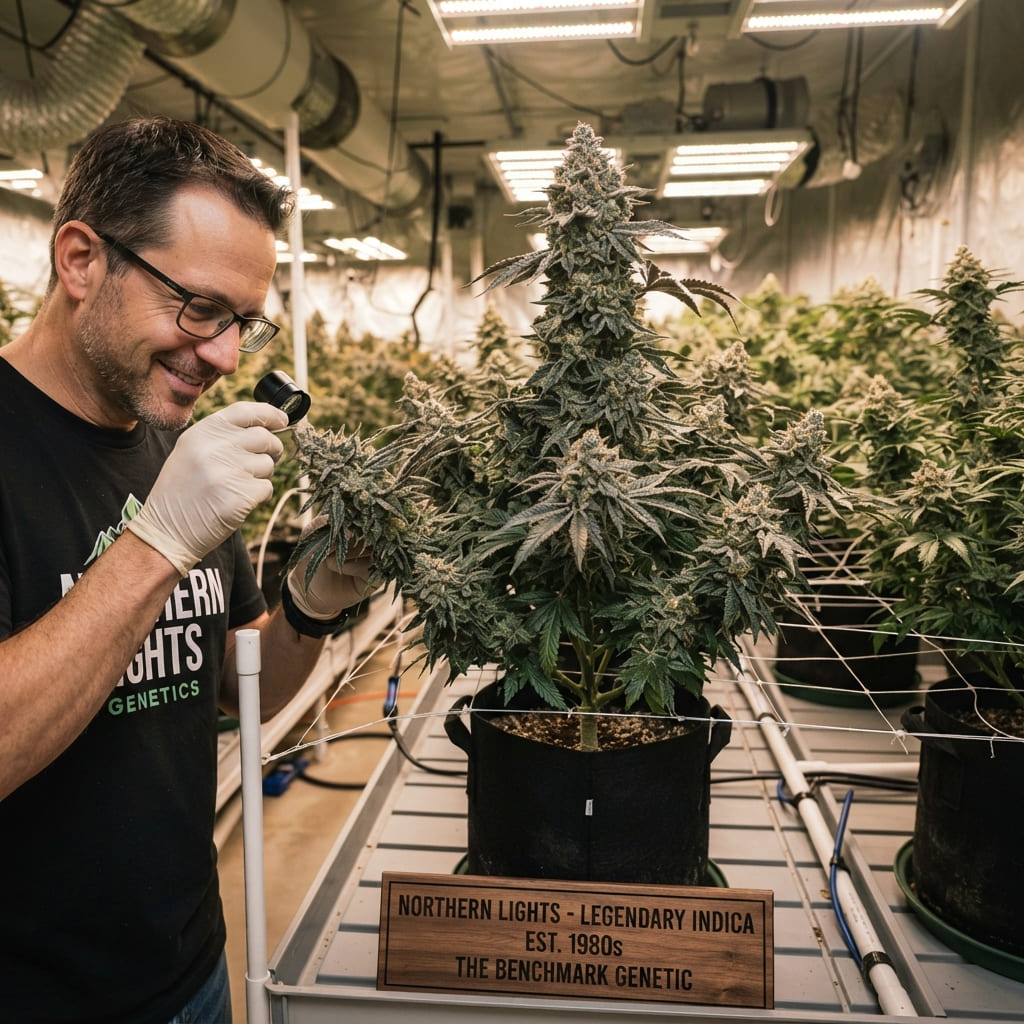
Why does a cannabis strain introduced more than forty years ago still serve as the benchmark for modern indicas? Picture the breeding world in 1985: no internet, no global seed banks, and no easy way to verify a strain’s lineage beyond trusting the person who handed you a handful of seeds or a clone. Into that landscape arrived Northern Lights, a cultivar that would go on to define what growers expected from an indica long before terms like “benchmark genetics” became common.
Four decades later, its influence remains remarkably strong. Breeders still compare new releases to Northern Lights, describing them as stronger, faster, or more terpene-rich versions of the classic rather than treating them as entirely separate creations. That enduring reputation is no accident. It reflects a strain whose stability, consistency, and breeding history have made it one of the most influential foundations in modern cannabis genetics.
An Origin Story That Actually Holds Up to Scrutiny
Northern Lights emerged from underground breeders in the Seattle area during the late 1970s as a cross between an Afghani indica and a Thai sativa landrace. The cross showed promise, but its lasting reputation came from what happened next. Australian-born breeder Nevil Schoenmakers took the genetics to the Netherlands, where he evaluated eleven different phenotypes before selecting NL#5 as the most stable and consistent expression.
That careful selection helped Northern Lights stand out from many other hybrids of the era. Its reputation continued to grow after winning 1st Place at the 1989 High Times Cannabis Cup, followed by additional awards in the early 1990s, establishing it as one of the most influential strains in modern cannabis breeding.
Why Genetic Stability Is a Real, Documented Problem in Cannabis
Northern Lights’ defining trait is not its potency or its terpene profile. It is stability, the fact that a seed pack from this lineage reliably produces the same plant, generation after generation, rather than the phenotype lottery common with modern hybrids.
That instability is not just an old-school complaint from growers nostalgic for “the classics.” A peer-reviewed genomic study published in PLOS ONE directly addressed this problem, noting that decades of large-scale, unrecorded hybridization across North America have made vernacular strain naming “unreliable and inadequate” for identifying or selecting cannabis genetics with any real precision.
The researchers found that genetic differences between modern commercial strains exist at a whole-genome level, not confined to a handful of cannabinoid genes, meaning two products carrying the same strain name can differ substantially in their actual genetic makeup.
That finding reframes why a strain like Northern Lights matters so much. In a market where a name alone increasingly tells you very little about what you are actually growing, genetics with a documented, traceable lineage and decades of consistent phenotype expression become genuinely valuable rather than merely nostalgic.
What Actually Makes Northern Lights a Benchmark
Strip away the nostalgia, and three specific things explain why this particular strain, and not the hundreds of other Afghani-Thai crosses attempted around the same era, became the industry’s measuring stick.
- A documented, verifiable lineage. Unlike most genetics from the era, Northern Lights’ Afghani × Thai cross and its selection into the NL#5 phenotype by Nevil Schoenmakers is a matter of recorded history, not folklore pieced together after the fact.
- A selection process built for consistency, not novelty. Schoenmakers ran eleven phenotypes before settling on one, meaning the strain’s stability was engineered deliberately rather than being a lucky accident that happened to breed true.
- A track record independently verified through competition. The 1989 High Times Cannabis Cup win, followed by multiple additional wins through the early 1990s, gave the strain a form of third-party validation most genetics from that period never received.
Together, these three factors are what let growers use “Northern Lights” as a genuine unit of comparison rather than just a nostalgic name, since the strain’s identity is anchored in verifiable history rather than reputation alone.
Understanding a Seed Bank’s Role in Preserving That History
Genetics this old only remain accessible if a seed bank actually maintains the lineage rather than letting the name drift across unrelated crosses over time, which is a genuine risk given how loosely strain names get reused. Understanding Northern Lights cannabis seeds in this context means understanding that not every pack sold under this name traces back to the same genetic root Schoenmakers actually stabilized.
Sacred Seeds, as an Australian seed bank, addresses this directly by documenting the Afghani × Thai lineage and NL#5 heritage behind its own Northern Lights catalogue entry, rather than relying on the name alone to carry the weight of the strain’s reputation.
What Made the #5 Phenotype the One Growers Kept Coming Back To
Schoenmakers did not simply cross two landraces and call it done. Running eleven phenotypes before settling on one reflects a deliberate selection process aimed at consistency, not just desirable traits in a single standout plant. The #5 phenotype delivered a compact, fast-flowering structure, roughly 7 to 9 weeks compared to the 12 to 16 weeks typical of long-flowering sativas at the time, which made indoor cultivation under artificial lighting commercially practical for the first time.
Heavy resin production from the Afghani parent, moderated by just enough Thai sativa influence to prevent total sedation, produced an effect profile distinct enough that growers could recognize it blind. Decades on, that same combination of speed, structure, and predictability is exactly what still draws new growers to the strain, particularly those running their first photoperiod grow.
Final Thoughts
Northern Lights earned its place as a benchmark through a specific, documented process: a promising cross, careful selection down to one stable phenotype, and decades of consistent performance that many modern hybrids, bred and renamed at a much faster pace, often cannot match.
That long history of stability is exactly what continues to make the strain relevant today, offering growers a level of predictability that is difficult to achieve through name recognition alone. For those seeking genetics with a proven track record, Northern Lights remains one of the clearest examples of what a deliberately stabilized lineage can deliver, even decades after it first gained worldwide recognition.