

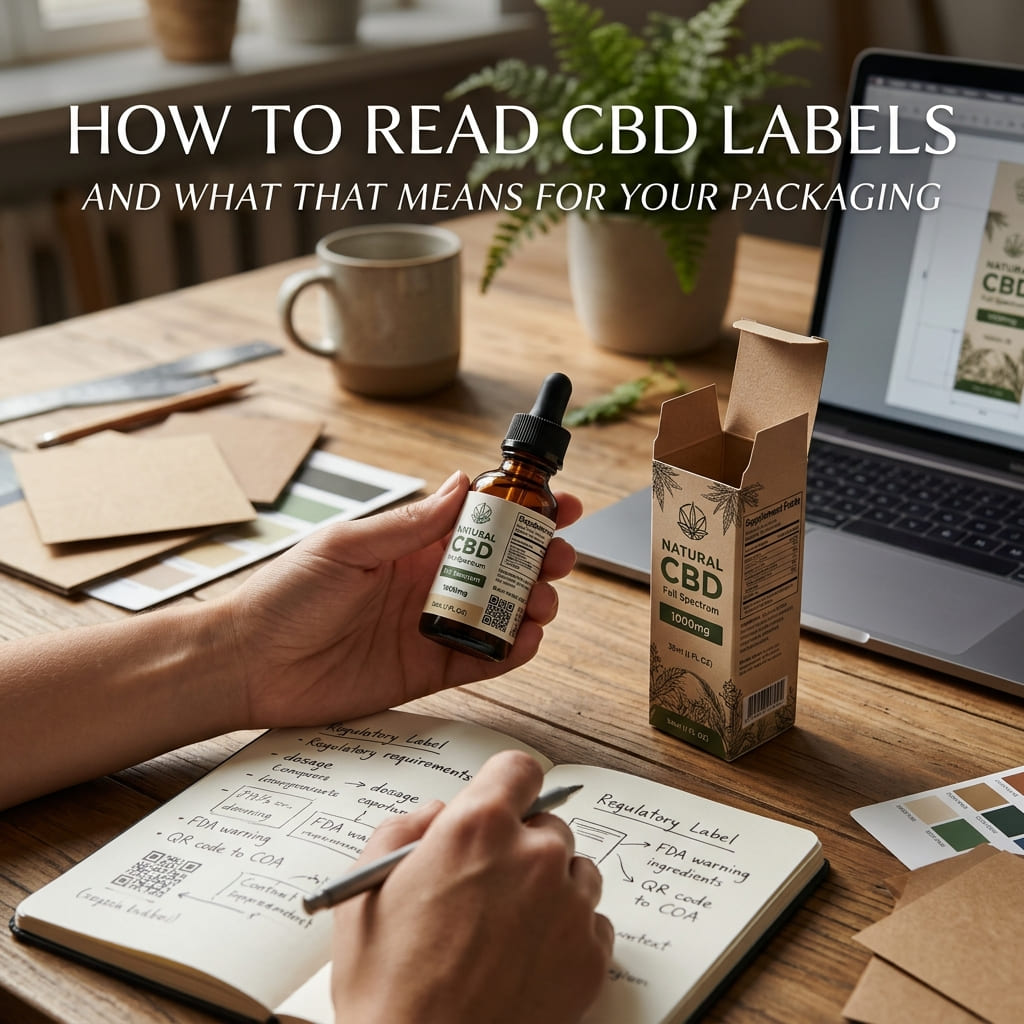
Knowing how to read CBD labels starts with five things: the total CBD in the product, the amount per serving, the type of extract, the batch details and a link to lab results. Customers who know what to look for check these before they buy. Customers who do not often walk away confused.
That is why this guide is written for CBD brand owners, not just shoppers. When you understand how people read your label, you can design boxes and bottle labels that answer their questions in seconds instead of losing them on the shelf.
Below, we walk through each part of a typical CBD label, the mistakes that cause confusion and how to lay out your packaging so it reads clearly.
Why CBD Labels Confuse So Many People
CBD labels pack a lot of information into a small space. A 30 ml tincture bottle may need to show strength, serving size, ingredients, batch number, warnings and a QR code, all on a label smaller than a business card.
On top of that, brands describe the same thing in different ways. One bottle says “1000 mg,” another says “33 mg per serving,” and a third lists “full spectrum hemp extract” without any CBD number at all. Customers comparing products side by side often cannot tell which is stronger.
Here’s the thing: a confusing label does not just frustrate customers. It makes your product look less trustworthy than a competitor with a clearer layout, even if your oil is better.
The Key Parts of a CBD Label
Most CBD products share the same core label elements. The table below shows what each one means and why customers look for it.
| Label element | What it tells the customer | Why it matters |
| Total CBD content | Milligrams of CBD in the whole product | Shows overall strength |
| CBD per serving | Milligrams in one dropper, gummy or dose | Helps customers compare products fairly |
| Serving size | How much counts as one serving | Makes the per-serving number usable |
| Extract type | Full spectrum, broad spectrum or isolate | Indicates what else is in the extract |
| Ingredients | Carrier oil, flavors and other ingredients | Helps people with allergies or preferences |
| Batch or lot number | Which production run the product came from | Links the product to its lab results |
| Lab results link or QR code | Access to the certificate of analysis | Lets customers verify what is inside |
| Manufacturer details | Who made or distributed the product | Builds trust and accountability |
| Suggested use and warnings | How to use it and any cautions | Supports safe use and compliance |
Total CBD vs CBD Per Serving
This is the number customers misread most often. Total CBD is the amount in the entire bottle or pack. CBD per serving is what someone gets in one dose.
A 30 ml bottle labeled 1000 mg might contain roughly 33 mg per 1 ml serving. If your label shows only the total, customers may compare it against another brand’s per-serving number and get the wrong idea.
The simplest fix is to show both, clearly separated. Put the total on the front panel, where it signals strength, and the per-serving amount near the serving size, where people look when deciding how much to take.
Full Spectrum, Broad Spectrum and Isolate
These terms describe what is in the extract, and customers increasingly look for them.
Full spectrum extract contains CBD along with other naturally occurring compounds from the hemp plant, which can include trace amounts of THC within legal limits.
Broad spectrum extract keeps many of those compounds but is processed to remove THC, typically to levels that are not detectable.
Isolate is CBD on its own, without the other plant compounds.
This is not a quality ranking. It is a description, and different customers want different things. Make the extract type easy to find, because someone who avoids THC will look for it first.
Batch Numbers and Lab Results
A batch or lot number connects a specific bottle to the lab report for that production run. That report, often called a certificate of analysis, shows the measured CBD content and other test results.
Many states expect this link to be easy to find. Texas, for example, sets out labeling rules for consumable hemp products that include batch details and a link to the certificate of analysis. Rules vary by state and change often, so check the current requirements wherever you sell.
A QR code on the box or label is the most common way to share lab results. Test it before printing, place it where it is easy to scan and make sure it leads to the report for that exact batch, not just a general page.
How to Design a Label Customers Can Read Quickly
Once you know what customers look for, you can design around it. A clear layout usually follows a few principles.
Front panel: the essentials. Brand name, product type, total CBD and extract type. Customers should understand what the product is from a few feet away.
Side or back panel: the detail. Serving size, CBD per serving, ingredients, suggested use, warnings and manufacturer details.
Bottom or back: the proof. Batch number and QR code to lab results, grouped together so customers can find and scan them easily.
A box gives you more room than a bottle label. Many brands keep the bottle label simple and move detail onto the outer box, which also gives the product a more premium look.
Common Labeling Mistakes to Avoid
Even well-established brands slip on these:
- Hiding the per-serving amount. Customers end up guessing how strong a dose is.
- Tiny text for key numbers. Strength should be one of the most readable details on the pack.
- QR codes that lead to the wrong page. A broken or generic link undermines trust.
- Health claims. Avoid suggesting the product treats or cures anything unless you have confirmed it is allowed.
- Inconsistent layouts across your range. Customers who learn one label should be able to read the next.
Designing a Range That Reads as One Brand
If you sell several CBD products, a consistent label system helps customers move from one to the next. Keep the same position for the brand name, strength and extract type on every box. Use one color per strength or product type, so customers can spot the one they want.
This consistency also makes reorders and new launches easier. A new gummy or topical can slot into the range without a full redesign, and your shelf space looks planned rather than pieced together.
Packaging That Protects the Product and the Label
A clear label only helps if it stays readable. Bottles that rattle inside loose boxes can scuff labels, and labels near oil can smudge if the wrong paper or coating is used.
Choose a box that fits your bottle snugly, with an insert where needed. A matte or soft-touch coating can protect print on the outer box, while a coated label resists oil on the bottle itself. Storing products somewhere cool and dry also helps both the product and the packaging last.
A Quick Label Review Before You Print
Before you send any label or box artwork to print, read it the way a first-time customer would. Hand a printed proof to someone outside your team and ask them to find the strength, the serving size and the lab results within a few seconds. If they hesitate, the layout needs work. This small test often catches problems that a design team, used to seeing the artwork every day, no longer notices.
FAQs
How do you read CBD oil labels?
Start with the total CBD in the bottle and the CBD per serving, then check the serving size and extract type. Look for a batch number and QR code linking to lab results to confirm what is inside.
What does the number in mg mean on a CBD label?
It usually shows the total CBD in the whole product. Check whether the label also lists a per-serving amount, which tells you how much is in one dose.
Are CBD boxes safe?
CBD boxes made from paperboard or rigid board are generally safe as outer packaging, because the product usually sits in its own sealed bottle, jar or pouch. If packaging touches food products like gummies directly, confirm it is suitable for food contact.
How should you store CBD gummies?
Keep gummies in their sealed packaging somewhere cool, dry and away from direct sunlight. Heat can make gummies soft or sticky, so avoid warm cars and sunny windowsills.
How should you store CBD flower?
Store CBD flower in an airtight, light-blocking container somewhere cool and dark. Controlling air, light and humidity helps keep it from drying out or losing aroma.
A Clear Label Is a Promise Kept
Customers cannot test your product in the shop. They trust the label to tell them the truth quickly, and the brands that earn repeat buyers are usually the ones that make that truth easy to read.
When you are ready to improve your packaging, CBD Boxes offers custom CBD boxes, tincture boxes and gummy packaging designed with clear label space. Talk to the team about layouts that suit your range.